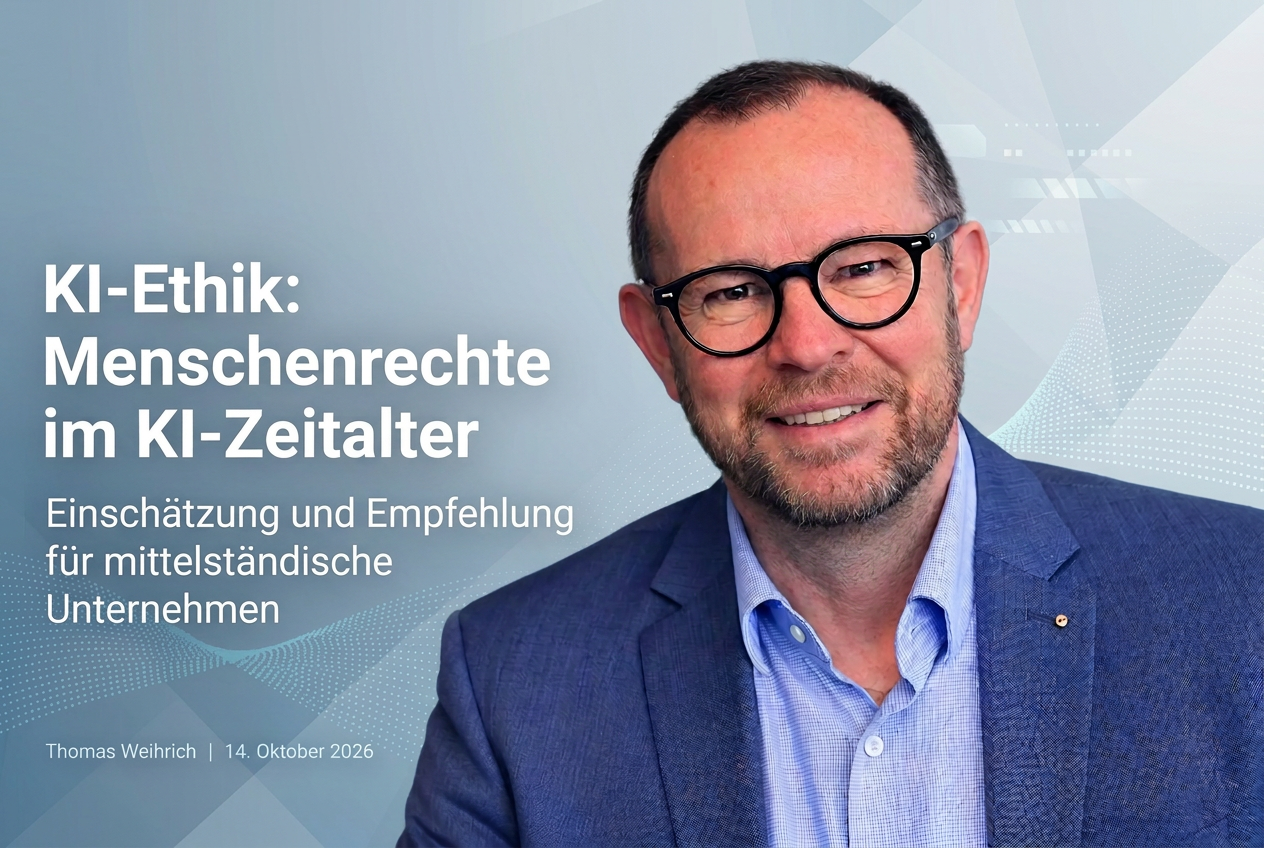
– Assessment and Recommendations for Small and Medium-Sized Businesses
Thomas Weihrich
October 12, 2026
Summary
In my first report, I explained why small and medium-sized enterprises should actively and carefully implement AI—despite (or perhaps precisely because of) the doomsday rhetoric from the major providers. One aspect was deliberately left open: the ethical dimension. It is now the focus of the SRF program “Perspektiven” featuring Lucerne-based ethicist Peter G. Kirchschläger, who advises the UN, the OSCE, and, most recently, the Pope. His message is clear: AI is not neutral. From raw material extraction through training to actual use, the process is fraught with human rights violations, breaches of data protection and copyright laws, and massive environmental damage. Kirchschläger therefore calls for global regulation and enforcement—and urges every individual to take responsibility for shaping the future.
My conclusion for SMEs: Ethics and productivity are not a contradiction, but two sides of the same coin. Anyone who implements AI makes ethical decisions—in the choice of models, data, and processes. This is exactly where Weihrich AI comes in: A multi-platform solution with nearly 75 language models and 40 tools gives companies a choice—and thus the opportunity to actively implement ethical principles rather than leaving them up to a single provider.
Background: The Show
On September 6, 2026, SRF’s “Perspektiven” aired an interview by Judith Wipfler with Peter G. Kirchschläger (approx. 30 minutes; available here). Kirchschläger is a professor of theological ethics at the University of Lucerne, president of the Swiss Federal Ethics Commission (EKAH), and an advisor to the UN, UNESCO, the EU, and the OSCE—and was appointed consultor by Pope Leo XIV in August 2026. His research contributed to the encyclical “Magnifica Humanitas,” whose core tenet regarding AI is “that AI must be disarmed so that it serves humanity and does not become a tool of domination.”
The Key Messages of the Program
- Human rights violations throughout the entire supply chain. Kirchschläger traces the life cycle of AI: Even during the extraction of raw materials, children’s rights are violated and slave-like working conditions prevail; in the countries of production, child labor and massive environmental destruction are added to the mix; and finally, during use, we encounter enormous energy and water consumption as well as violations of data protection, privacy, and copyright. “For the sake of the interests of a handful of multinational technology corporations,” says Kirchschläger, “the rest of humanity and planet Earth are essentially being exploited”—not in the future, but today.
- A voluntary commitment is not enough. The experience of the past two to three decades shows that voluntary commitments by corporations have not built trust. What is needed is human rights-based regulation at the global level—ideally through an “International Agency for Data-Based Systems” (IDA) under the UN. His historical model: the International Atomic Energy Agency, established during the Cold War. “If we merely create regulations but fail to enforce them, then those regulations aren’t worth the paper they’re written on.”
- Models are not neutral. Kirchschläger warns against “assuming” objectivity, fairness, and neutrality in generative AI: training data and algorithms inherently contain biases. His image of the “ruminating cow” sums it up: Truthfulness is simply not a criterion for these systems—“for example, ChatGPT doesn’t even care whether what it spits out is true or not.” Whoever controls a system has “an incredible amount of power to decide what answers users receive.” He cites the example of Grok (Elon Musk), which answers a sensitive historical question differently than other models—depending on the operator’s interests.
- “Ethics-washing” instead of ethics. The industry portrays itself as a “good AI company,” but it’s in the same business as everyone else: During training, copyrights are systematically infringed upon—content from media outlets, publishing houses, and research institutions is “stolen,” which deprives artists and scientists of their livelihood.
- Take opportunities seriously—manage risks. Kirchschläger is not one to shy away from the issue: AI can “move mountains” in research, medicine, and mathematics. The key point is: “Ethical risks are not the price we have to pay to enjoy ethical opportunities.” Data breaches are not a law of nature—there are also AI tools that do not violate privacy. He also warns against the degeneration of cognitive abilities due to the convenience of everyday use and against surveillance that standardizes our behavior and thinking. His advice for ensuring humanity’s future viability: interpersonal interaction, critical thinking, creativity, and moral capacity—abilities that fundamentally distinguish humans from machines.
My view: Ethics is about shaping, not sacrifice
Kirchschläger’s personal advice is to use these systems “as little as possible” and to think for yourself. For individuals, this is a legitimate approach. For a company, however, it is not: Four out of five people in Switzerland already use AI for practical matters, and those who don’t participate in their day-to-day work will fall behind. The reality in most SMEs is “shadow AI”—employees have long been using consumer tools, unnoticed by management, resulting in an uncontrolled outflow of data.
This is precisely the “lever” that Kirchschläger himself refers to when he speaks of the responsibility to shape the future: “So-called AI doesn’t just fall from the sky; rather, we humans should decide which AI we develop, which we don’t, whether we use it, and how we use it.” This decision isn’t made only in Geneva or by the Pope—it’s made in every company, every day. Ethics doesn’t begin with global regulation, but with the question: Which model for what purpose, using what data, and under what rules?
Recommendation for Small and Medium-Sized Businesses
The answer, therefore, is not to do without it, but rather to introduce an AI platform in a controlled manner that offers choices. Weihrich AI (based on Hatz AI) combines nearly 75 language models and 40 tools into a single, centrally managed platform—thereby making ethics an active decision:
- Choosing Models as an Ethical Tool: If you are not reliant on a single provider, you can select models based on criteria—quality, data protection, transparency, and the provider’s practices—and switch providers as needed. The Auto Model Selector selects the appropriate model for each request; as a company, you set the default settings yourself. Those who use only one provider leave the ethical questions up to that provider’s business model.
- Privacy by design: Your company data is not used to train the models—this is the key difference from many freely available tools and a direct response to the human rights violations in data protection and privacy that Kirchschläger has criticized.
- Clear Rules Instead of Shadow AI: Centralized policies, roles, and access control; logging; and “human-in-the-loop” oversight for critical processes. We identify the existing shadow AI in your company and replace it with a regulated alternative—innovation without data leakage.
- Train critical thinking rather than letting it atrophy: The integrated learning modules and training courses empower your employees to scrutinize AI-generated answers rather than accepting them unquestioningly—exactly the skill that Kirchschläger identifies as a key competency for the future.
- Phased implementation with governance: pilot applications with measurable benefits, defined approvals, and regular reviews—in line with the guidelines of the EU AI Office and the OECD for SMEs.
Conclusion
Peter G. Kirchschläger convincingly demonstrates that AI is not neutral—and that the course is not set in California alone, but by everyone who uses AI. For small and medium-sized enterprises, this means that ethics is not a hindrance, but rather a defining feature of a professional AI implementation. Those who have a choice between models and providers, who control the data flow, and who train their staff can reap the productivity gains of AI—without uncritically accepting the associated human rights and data protection risks. That is exactly what we achieve with Weihrich AI: productivity and human dignity are not mutually exclusive.
Sources
- SRF Perspectives: “Peter G. Kirchschläger Fights for Human Rights in the Age of AI” (September 6, 2026): srf.ch/audio/perspektiven/peter-g-kirchschlaeger-kaempft-fuer-menschenrechte-im-ki-zeitalter?id=AUDI20260905_NR_0010
- My first report: “AI Doomsday Warnings from Major Providers” (September 21, 2026): weihrich.ch/ki-weltuntergangswarnungen-der-grossen-anbieter/
- Vendor Page: The Secure AI Platform for SMBs & MSPs – Hatz AI: hatz.ai
- Partner Website: Weihrich AI – Weihrich Computer Science: weihrich.ch/weihrich-ki/
- Overview of integrated models and tools: weihrich.ch/unsere-integrierten-llms