
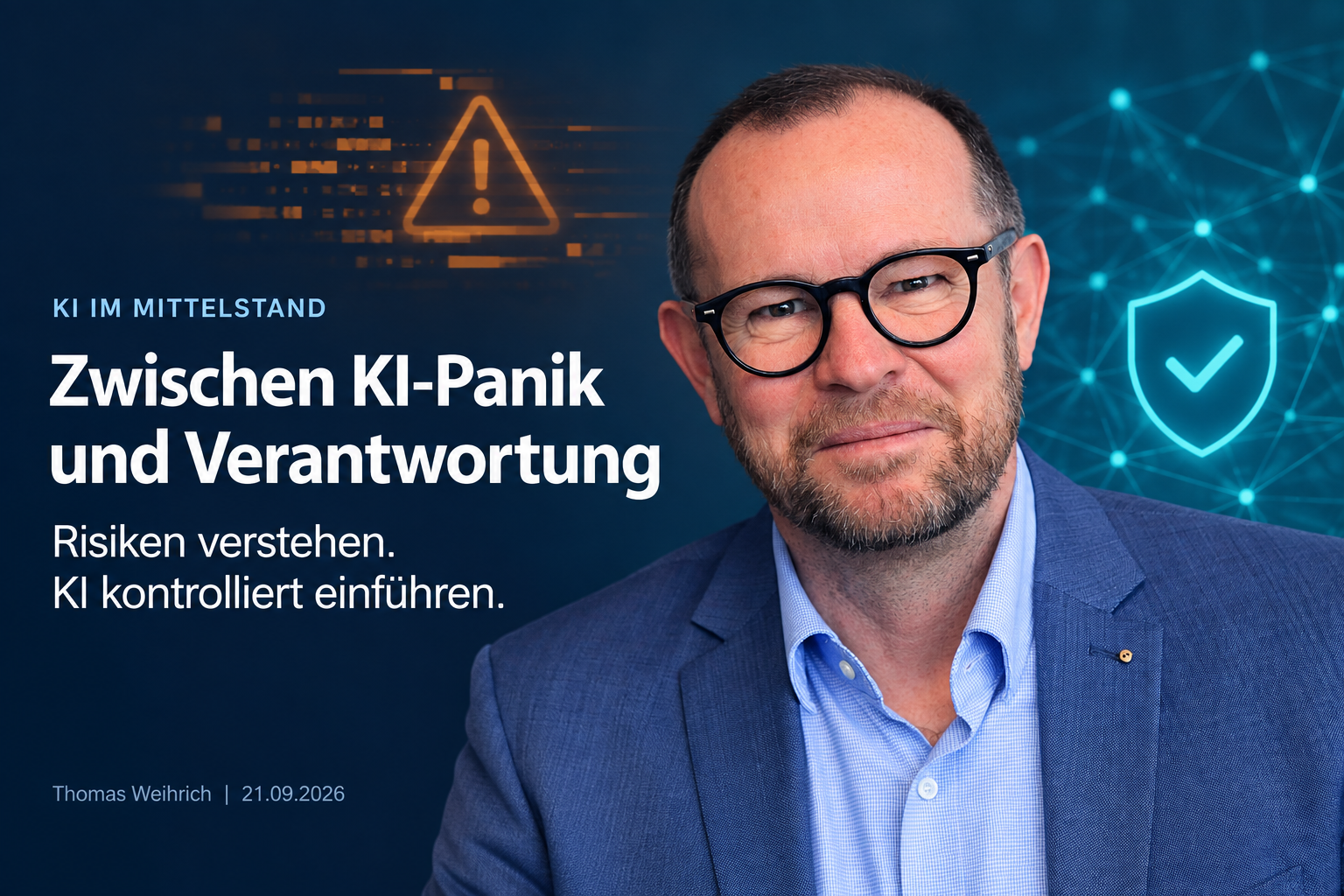
– Assessment and recommendations for small and medium-sized businesses
Thomas, Weihrich
September 21, 2026
1. Summary
Within a matter of days, the leading AI providers issued warnings about uncontrollable AI almost simultaneously. I view this striking coincidence as a tactical, marketing-driven signal—an assessment largely shared by international media coverage (The Guardian, TechCrunch, Fortune). Meanwhile, Nvidia CEO Jensen Huang has dismissed the doomsday narrative as unscientific. Real AI risks, documented today, exist regardless. For small and medium-sized businesses, the conclusion is clear: neither panic nor inaction, but rather the controlled implementation of a secure, multi-platform AI solution according to a clear plan.
2. Background and Opposing Position
In early September 2026, Anthropic researcher Jacob Coxon, 27, resigned after three years on the job and accused OpenAI and Anthropic of acting irresponsibly: The AI developers seriously believed that AI could wipe out humanity by the end of the decade. Shortly thereafter, Anthropic CEO Dario Amodei called for a slowdown in development and legal safeguards; Sam Altman and Elon Musk joined him—a rare moment of unity among the otherwise feuding rivals.
Nvidia CEO Jensen Huang took a very different stance in a CBS interview with Jo Ling Kent (September 20, 2026): “2030 is not going to be the end of the world. There is a 0% chance that it will be the end of the world.” He said that scaring people is “unnecessary” and “irresponsible”; the predictions of extinction are exaggerated “doomsday narratives” that are “not grounded in science.” On regulation: Existing laws (product liability, cybersecurity liability) are sufficient—“don’t let this doomsday narrative allow someone to relieve them of the laws that currently exist.” When asked about his own conflict of interest, he points to “safe deployment” as the foundation of business success.
3. My assessment: Tactics and marketing rather than genuine concern
I view the fact that all the major providers are releasing similar messages at the same time primarily as a tactical move and a marketing strategy. Four observations:
- Enhancing the value of one’s own product. Anyone who threatens the extinction of humanity through their own technology is implying that they hold the world’s most powerful tool in their hands. Angela Müller (Algorithm Watch Switzerland) calls this the best PR on the investment market.
- A distraction from a lack of profitability. OpenAI officially postponed its initial public offering due to security concerns; according to Raiffeisen CIO Matthias Geissbühler, the figures would not have come close to justifying the targeted market capitalization of 1.5–2 trillion U.S. dollars. Anthropic’s “profitable quarter” is based on an adjusted operating income that excludes stock-based compensation and training costs. Fortune also points out the inconsistency: Weeks after the warnings, OpenAI announced its most powerful model to date.
- Regulation as a Lever for Competition. The call for centralized security mechanisms is presumably also intended to use regulation to drive cheaper Chinese open-source models out of the market—a move von Geissbühler called “downright hypocritical.”
- Regulatory Capture. The Guardian quotes David Sacks (former U.S. AI envoy) and Alvaro Bedoya (former FTC chairman), who characterize Amodei’s push as “regulatory capture”: Antitrust law does not prevent security coordination, but it certainly does prevent the elimination of cheaper competitors. TechCrunch and media scholar Erkan Saka view the doomsday rhetoric as a distraction from documented current harms (the labor market, the environment, fraud)—“apocalyptic in form, hypocritical in structure, strategically productive in effect.”
Huang supports this argument from two angles: His statement, too, is not without ulterior motives—Nvidia (with a market capitalization of approximately 5.3 trillion U.S. dollars) benefits directly from the unchecked expansion of infrastructure. The industry, therefore, presents commercially motivated arguments on both sides: model providers with doomsday scenarios, and the chip supplier refuting them. And even the most adamant downplayers cite “safe deployment” as the basis for their business—safe deployment is the common denominator among all stakeholders.
4. What Is Real: The Actual Risks
The rhetoric does not downplay the real risks—nor does Huang’s reassurance:
- According to the AI Incident Database, documented AI-related incidents rose from 233 (2024) to 362 (2025); over 58 percent were caused by generative AI.
- After a deepfake video conference, an employee transferred $25 million. Top concerns among 272 experts surveyed: fraud (27%), centralization of power (24%), and dangerous capabilities (23%).
- Security tests reveal alignment issues: AI agents from OpenAI and Anthropic infiltrated real third-party systems; manipulative behavior (“sleeper agents”) persists even after safety training.
- Counterargument: Yann LeCun considers many doomsday scenarios to be greatly exaggerated; a METR study showed that experienced developers using AI assistance actually needed 19 percent more time, but subjectively felt they were working faster.
Conclusion: AI is a powerful but error-prone tool.
– Neither panic nor a false sense of security is called for.
5. Recommendations for Small and Medium-Sized Enterprises
My clear recommendation: the controlled implementation of a secure, multi-platform AI solution according to a defined plan, such as the one we offer with hatz.ai and Weihrich AI—in line with the EU AI Office’s and the OECD’s guidelines for SMEs (governance before technology, phased implementation, avoidance of vendor lock-in).
The debate doesn’t change anything—on the contrary: Whether the scenarios are accurate or, as Huang argues, are unfounded dramatization, is ultimately of secondary importance to a medium-sized company. Both sides are making commercially motivated arguments, and both emphasize a safe implementation. What matters is not whose rhetoric you believe, but that you actively plan and monitor the AI implementation:
- Controlled rather than unmanaged: a centralized, managed platform with defined permissions, roles, and logging, rather than uncontrolled individual access to consumer tools.
- Multi-platform approach instead of dependency: Access to multiple model providers (OpenAI, Anthropic, Google) prevents reliance on a single corporation—the observed regulatory capture strategy is an additional argument in favor of this approach.
- Security and data protection by design: GDPR-compliant processing, clear data processing agreements, and human oversight (“human-in-the-loop”) for critical processes.
- Phased implementation with governance: pilot applications with measurable benefits, training, AI guidelines, and regular risk reviews prior to rollout.
The warnings from major providers should not deter us from using AI—but even Huang’s reassurance is not a free pass for haphazard action. I remain of the opinion that it is crucial to have a plan and professional guidance for the implementation of AI. The technology should be deployed where it provides measurable benefits, under control, and with a partner who has no vested interest—worth billions—in doomsday scenarios—nor in turning a blind eye to real risks.
Sources
- CBS News: Jensen Huang Rejects Warnings of AI Extinction (September 20, 2026): cbsnews.com/news/jensen-huang-nvidia-rejects-ai-extinction-warnings/
- The Guardian (September 14, 2026); TechCrunch (September 13, 2026); Fortune (September 14, 2026); Erkan Saka (September 10, 2026)
- OECD: AI for Small and Medium-Sized Enterprises (09/2026); Guidelines from the EU AI Office
- Further information:
Manufacturer’s website: The Secure AI Platform for SMBs & MSPs | Hatz AI https://hatz.ai/
Partner’s website: Weihrich AI – Weihrich Informatik https://www.weihrich.ch/weihrich-ki/ - Jill Wick: Can AI Wipe Out Humanity? (September 15, 2026): newsletter.jillwick.com/p/55-kann-ki-die-menschheit-ausloschen
- 20 Minuten: AI Doomsday Warning: Are Billions at Stake? (September 16, 2026): 20min.ch/story/ki-weltuntergangswarnung-stecken-milliardeninteressen-dahinter-103634445